
![[Share]Twitter](/common/img/lab/sns_tw.png)
![[Share]Facebook](/common/img/lab/sns_fb.png)
論文
Rintaro Tanimoto, Kazuhide Miyamoto, Tamura, Shigeru Kondo, Junpei Kuroda
A collagen orientation switch reshapes fin architecture
bioRxiv (2026)
https://doi.org/10.64898/2026.01.17.700086
https://www.biorxiv.org/content/10.64898/2026.01.17.700086v1.full
解説
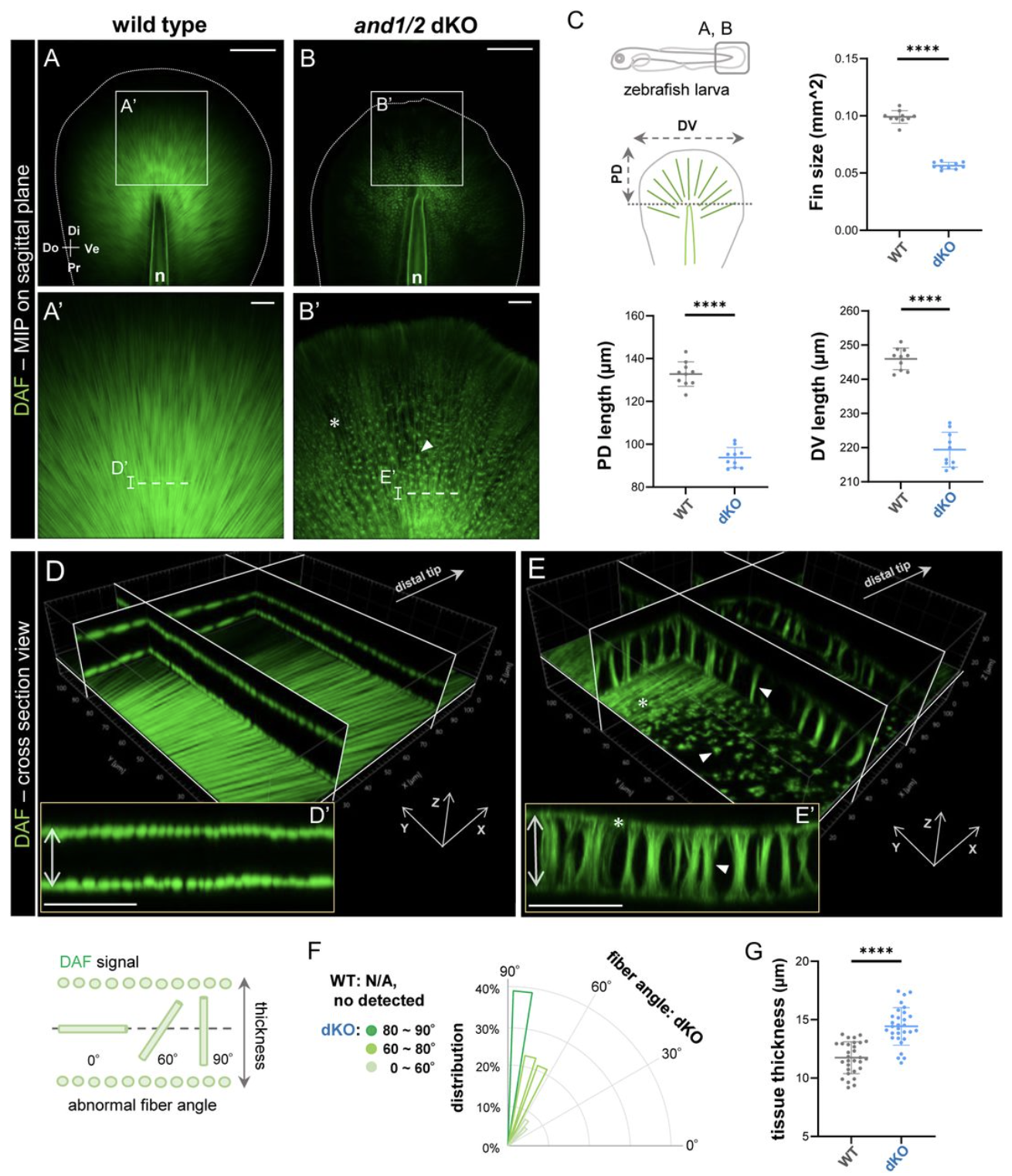
The orientation and distribution of fibrillar collagen are critical determinants of the shape and mechanical properties of bones and organs. However, how they are spatially organized within tissues is still poorly understood,as visualizing these collagen architectures remains challenging. Actinotrichia (AT), the spear‑shaped fibrillar collagen structures located at the distal tips of fish fins, are easily observable due to their large size and distinctive morphology and have recently emerged as a model system for studying collagen fiber organization. In this study, we generated knockout lines for the fish-specific extracellular matrix (ECM) genes actinodin1 and actinodin2 (and1/2), which are lost in tetrapods. Loss of these genes dramatically altered the orientation of collagen fibers, thereby inducing changes in fin morphology. In the wild‑type fins, AT are orderly arranged beneath the epidermis, forming layers parallel to the fin surface, and their individual fibers radiate distally toward the fin tip. In contrast, double knockout (dKO) of and1/2 results in overall fin reduction accompanied by increased thickness. Examination of the collagen structure distribution revealed the presence of aberrant collagen fibers oriented perpendicular to the fin epidermis. Moreover, the vertically oriented fibers contributed to thickening of the mesenchymal region in which they were distributed. The number of abnormal fibers increased with the severity of and1/2 deficiency, suggesting that collagen fibers in fins inherently tend to align perpendicular to the epidermis when these genes are absent. Furthermore, in tetrapods lacking the and gene family— specifically amphibians, the tetrapod group most closely related to fish—examination of the developing limb, the organ homologous to paired fins in fish, revealed collagen fibers oriented perpendicular to the epidermis. The distribution pattern also resembled that observed in the fin buds of and1/2 dKO fish. Together, these findings highlight collagen patterning alterations as a previously unrecognized factor contributing to the evolutionary divergence between thinned fins and thickened limbs. Moreover, the identification of mutants that dramatically alter collagen fiber orientation is unprecedented, suggesting that analysis of Actinodin (And) function unveil the mechanisms underlying collagen matrix formation.