
![[Share]Twitter](/common/img/lab/sns_tw.png)
![[Share]Facebook](/common/img/lab/sns_fb.png)
論文
Miki Iwasaki, Junpei Kuroda, Masanori Nakae, Hironori Wada
Skeletal remodeling is responsible for the foramen in the skull for the hyoid artery in zebrafish
Developmental Biology (2026)
https://www.sciencedirect.com/science/article/abs/pii/S0012160626001302?via%3Dihub
解説
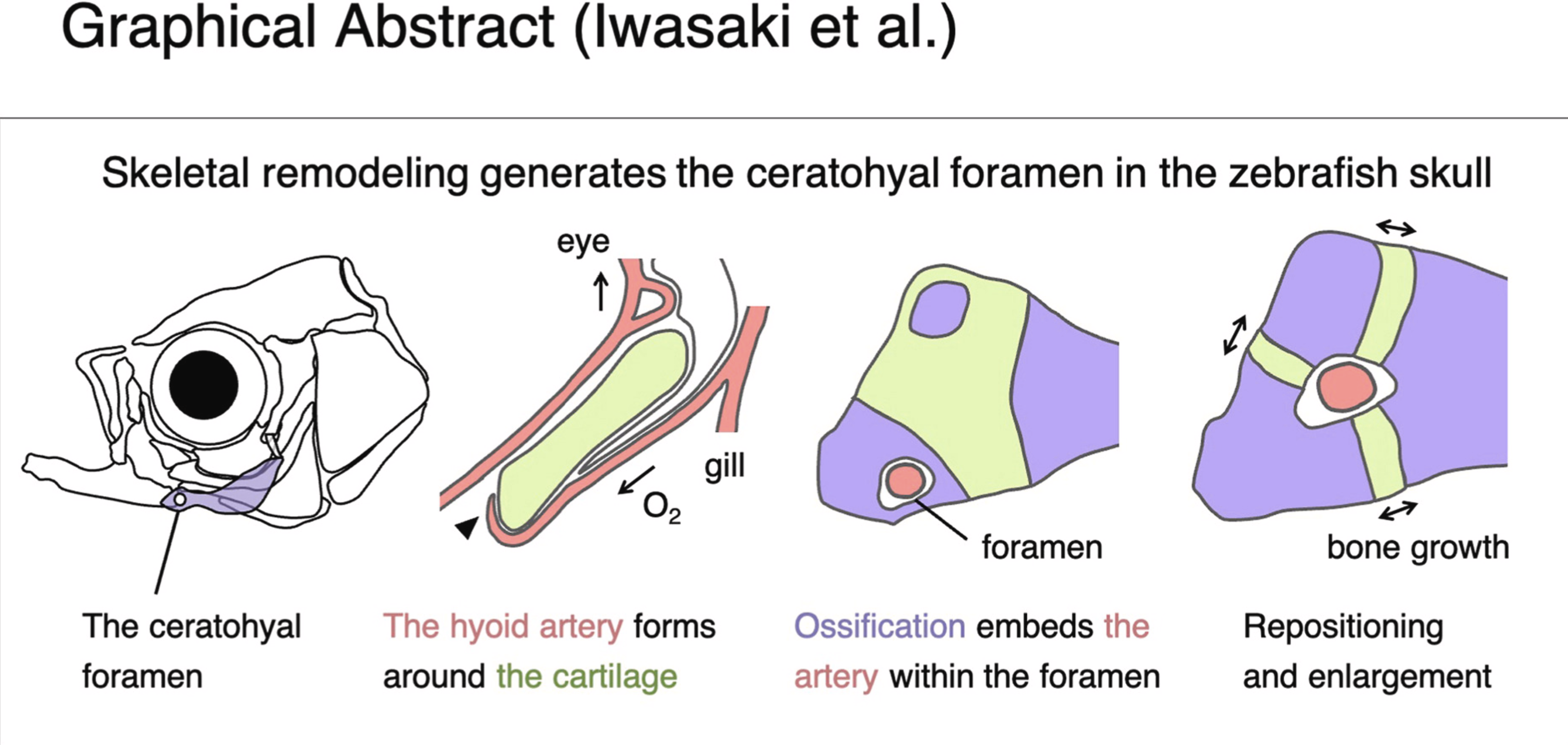
Many nerves and blood vessels become embedded in bones during the development of vertebrates. Subsequent skeletal remodeling, however, enables the organisms to grow without interfering with the vascular or nervous functions. Here, we demonstrate that the zebrafish ceratohyal (Ch) foramen, a passage for the hyoid artery supplying blood to the eye, enlarges by bone growth rather than bone resorption. The Ch foramen is surrounded by a ring of three bones partitioned by cartilaginous growth plates, whereby bones are deposited bidirectionally as the fish grow. By contrast, during the larval to juvenile stages, the Ch foramen is formed through a mechanism of bone and cartilage resorption. We demonstrate that the hyoid artery forms along the surface of the cartilage template but becomes embedded within the Ch foramen after ossification. Then, the Ch foramen repositions to the space surrounded by the bones after extensive skeletal remodeling. Genetic ablation of osteoclasts and mechanical ablation of the artery similarly disrupt the repositioning of the Ch foramen, indicating that the process requires osteoclasts recruited by the hyoid artery. Interestingly, medaka lacks the Ch foramen together with the hyoid artery, suggesting an essential role for vascularization in skeletal patterning during evolution. The present study reveals novel mechanisms for local bone morphogenesis through interaction with surrounding tissues and provides insights into the evolution and development of the vertebrate head skeleton.